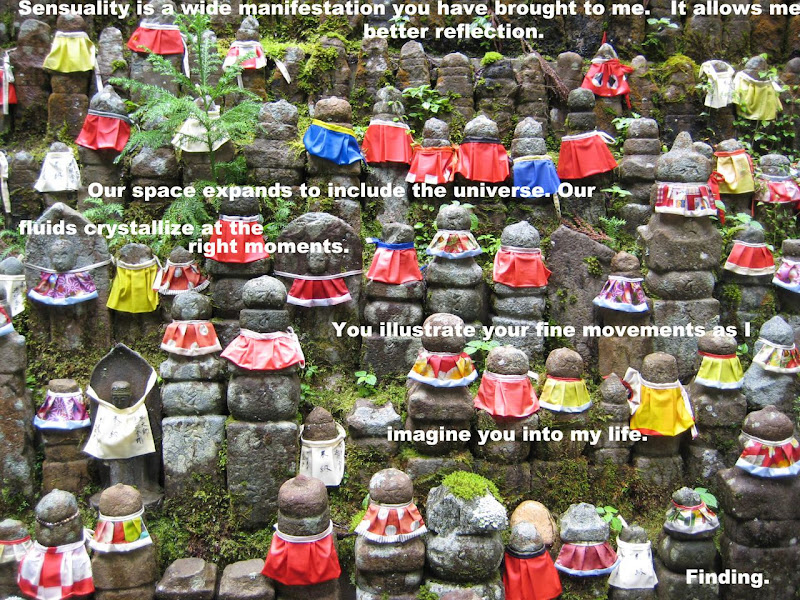
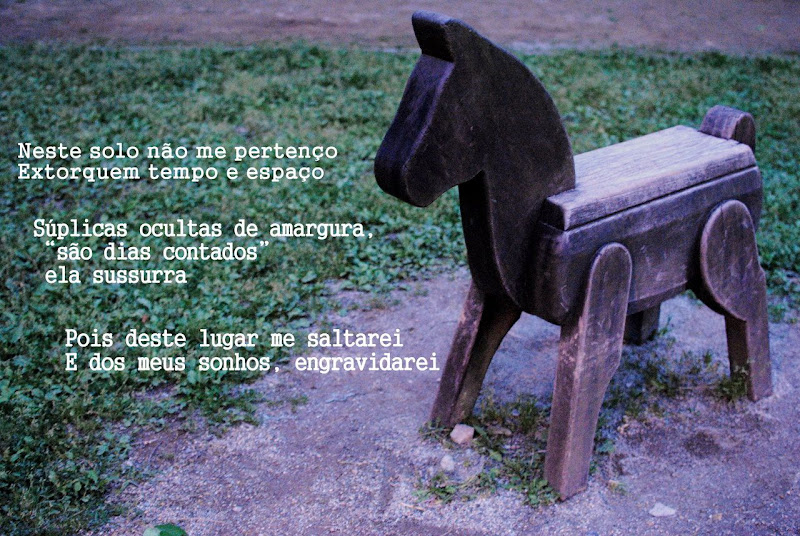
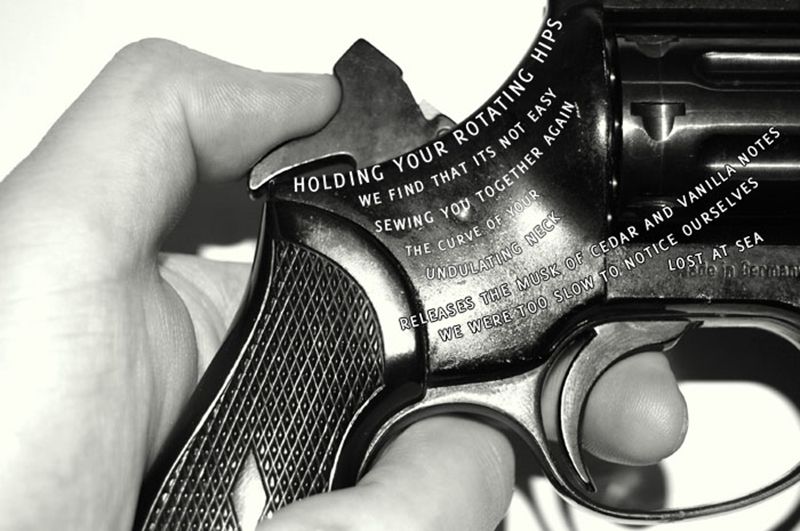
How I feel when I write is how I felt in my very first typophoto: from the white chatter and turbulent swirl of life's stream, I emerge in stillness, calm. The air into which we are all dissolved is laden with our songs, crossing oceans to flow through us. In that moment of stillness I breath my song into that zephyr, and let if fly with the great harmony.
As you will see, I owe the shape of this epiphany to Justin Tan and Hanna. The premise is simple: we share photographs, we react, and then we write on them. I present for your edification some of my favorite typophotos. I'll let their words wash over you. Experience more of their work (or my own attempts) here.
Words: Hanna Photograph: Jordan Baylon
"Saudade" Words: Justin Tan Photograph: Marina Mayumi
And here are some typophotos I admire from frequent collaborators and friends of the project:
So I was at a concert, and it was phenominal btw... I came up with an idea... and as I tossed it around inside my head, thinking about how I'd represent it, I came out with a tryptich... kinda like last time in a sense... But I didn't have that in mind when it came out. Just coincidence I suppose. I came home and stayed up late to get it done; I was pretty excited about it. Anyways I'm excited to see your approach.
It's meant to be read in whichever sequence you'd like.
We'll talk tomorrow. I'm meeting up with Peter tomorrow for din and stuff, so it might be a bit later.
Hey bud. Here are a couple sketch-ups of the two ideas I was thinking of on how to arrange the text. The first image is to be paired with the security camera, and the second is to be paired with the pigeon. The third I'm still working on, but I wanted to see what you thought of these two panels. I'm trying define the 'field of gaze' in these two panels. I think the second one, for the pigeon, is kind of a narrative. But with both I'm suggesting a movement through space and the encounters within this space.
[In] the pigeon panel I was having a bit of fun with the idea of the lines, and how they intersect with the 'objects' within the field.
Mark: Do u think the tryptich is ready to be posted?
Jordan: I was going to ask you about that: what does the final post look like in your mind?
M: Hmm, I think it should be just the three panels laid out vertically. Perhaps we include the paragraph that has all the words together at the bottom. What do you think?
J: I agree [...] Also, I just want to recap w you what you think we are saying with this. Looking at the constituent parts, it’s easy to see comments about the nature of sight, perception, and subjectivity. But, especially w regard to the last image, what is the overarching idea? [...] It’s very strong, but even I’m trying to articulate it clearly. This one’s on you. Once we finish this we can talk about the Lisa’s Place piece that’s been put on the back burner.
08/28/2010
Mark (text): I wrote some notes on it in my sketchbook... It's more clear in my head, perhaps we can talk it out.
08/29/2010
Mark (email):
K, it's really raw, just thoughts put down:
First Panel: Surveillance
Finding order in disorder
Checks and balances
Significance of orange: a building (human construct) to which the camera attaches itself. In the city, one does not exist without the other. [The camera] watches for glitches in the pattern of the city.
Self-awareness, self-consciousness
Second Panel: Pigeon
Finding disorder in order
The pigeon follows it's instincts, a pattern that would be no different in nature. The pigeon calculates its next move by watching for things like a fallen crumb, an accidental dropping of a pizza slice... a ripped garbage bag... opportunities. The pigeon accepts the city and its inhabitants as part of the natural order. It adapts to us, and grows with us.
Complete lack of self-awareness- it simply exists
Third Panel: the Lens/Eye
Perception: defined vs. undefined purpose
We know that the commonality between [the camera and the pigeon] is that they both have an awareness of humanity, but for different reasons. One exists as part of and the other exists as separate from. The pigeon exists as part of and within. The camera exists as separate from and outside of. The camera lens represents self-awareness. The unseen eye above. Would there be chaos without it? What if we relied on the eye on the pigeon rather than the eye of the camera? We are a part of nature but we've convinced ourselves otherwise.
The Text
The text inside a result of the text on the periphery. The funny thing is that neither the lens nor the pigeon are necessarily conscious of these sensations, or able to acknowledge them. What's lacking is the human eye. Perhaps the two combined/overlapping can be said to represent the human eye.
K Jord, this still feels a bit mumbo jumbo, it's a tough one to unravel. I feel like I'm getting somewhere though, especially with that last sentence. I feel like it's a pretty tight visual though... I feel like it makes sense, but I can't explain it just yet. Hopefully what I wrote will stimulate some thought on your side and we can talk it out.
Jordan (text): Ok just read it. I'll email my notes in a lil bit. The destination looks good, but reconfiguring some of the ideas may help us actually get there. Gimme a bit.
...
Jordan (email):
Alright, these are my thoughts. Hopefully they stimulate a productive dialogue: in other words feel free to argue with me haha.
First Panel: Camera
While the camera's purpose is to maintain order, it does so by searching for disorder, or as you say "glitches in the pattern of the city."
Also, I find it interesting how you align it with the concept of self-awareness. A camera, in and of itself, is neither concerned or even aware of what it sees. It takes a person to interpret the data of the feed to determine what constitutes a disturbance or transgression of order. But consider the durable movie cliche of the security guard napping in front of a dozen surveillance feeds, only to perk up when an alarm goes off: the vast majority of what the camera "sees" is not seen at all. If nothing of interest happens or is noticed, the footage is deleted or stored in mouldy boxes. In reality, the camera functions more as a detterent: those who see it are told they are being watched, which stimulates an awareness of what they themselves are doing. Therefore, beinglookedatis more important than looking.
The camera is a non-participant or passive element in the city, standing apart from all action, never touching anything.
Second Panel: Pigeon
The pigeon is, as you point out, part of the natural order; but it too is searching for disorder. It must compromise by exchanging seeds, grain, and fruit for the left-behinds of mankind. But in doing so it has not compromised its nature (which is to forage), only the object of that nature (the type of food it forages).
I agree that the pigeon represents a complete lack of self-awareness, but so does the camera. What is important is that despite having no sense of self, it is searching actively for its goal, right under the noses of mankind, often completely ignored. So looking is more important than being looked at.
The pigeon is an active, even if unnoticed, participant in the action.
Third Panel
The camera is, as you point out, a necessary part of the city, but separate from the action that takes place in it. The pigeon does not belong to the city [naturally], but is a part of its ecosystem. And when we talk about the city, what we are really talking about are people. So rather than assigning each to one side of a rigid inside/outside binary, we should consider both the camera and the pigeon as metaphors for mankind, each one demonstrating a strange paradox of being bothinside and out, natural and unnatural.
On the one side, we have the pigeon which represents our animal nature, and the camera which represents our evolution from that origin (for better or worse). The pigeon searching single-mindedly for food, attempting at all costs to fulfill a biological imperative, is like the base impulses that drive us (survival, reproduction, etc). The camera watching but not seeing, expecting something that may or may not happen, is like humanity in its evolved state. Consider that for civilization to develop, humanity first had to develop a consciousness of the self. Once the former animal has this, it can look past its nature, accumulate knowledge outside of what has been programmed into its genes, and create tools, shelters, cars, and cities. Only the creature that knows that it will eventually die would have the forethought to make things to prolong its life. So the camera is the eye we turn towards ourselves, to make us mindful of our nature in the world, and to regulate our actions (of away from nature).
So to misquote you, humans are "a part of nature but also separate from it." Neither the former [condition] nor the latter can be removed without ceasing to define human beings. So while the pigeon is concerned with objects (nouns) and the camera is concerned with actions (verbs), it is only the human being, a combination of the two perspectives and thereby self-aware, that is concerned with emotions, qualities, and the essences of things (adjectives).
So what do you think? Did we unlock it?? hehehe...
(text)
M: Wow, it's what I was trying to say, it's so clear now.
J: Are you for real: you're not just kissing my ass or sparing my feelings?
M: No man, for real, it's sick.
J: See? You're the proof and I'm the pudding son hehehe That shit is undeniable.
M: Hi fives. Should this be posted? I think so.
J: Should what be posted?
M: Well, a version of it perhaps? The analysis.
J: Hmm, remember I've always been interested in showing our process in a piece... can that be done here do you think?
M: Dude, we'll talk about it tomo yah? In REAL LIFE. Sweet.
I always have to start the same way. I sit. I stare. I make little compromises with the moments. When my heart is full I speak. When I'm with you I always forget that I am 20 feet tall and that my voice can be oppressive; but how do I explain that the mass of being housing those words is just a cluster navigating the pull of the thing inside me, something I've hidden away and whose gravity I stand to, a stable anchor and the loneliest prison by turns? It is so small, but dense beyond the weight of my own life to ever mitigate it completely; for better or worse it defines me. I told you that if I dared to touch it, my world would change forever. And of the many scenarios it is not obliteration, but desolation that I fear, that there will be nothing to reflect colours and that in a barren apathy I will preside over the graves of the tears and the laughter. But there are flowers in Hiroshima.
We walk and we talk. We walk away and are drawn back again, orbitting the space we share. We vibrate and we echo over the shapes we pass. We walk down the street together, spending words thriftlessly, but there is the comforting stillness of the earth itself rooted to us. We alight upon a hill and sit, steeping in silence, and my new senses open to track the rush of soft orange light as it floods the rooftops, slides liquid under the stars and returns to wash and enfold us. At night the universe is unbounded, undelineated, and infinite; by its graces I cloak myself with it and clumsily map other people's dreams. But with you I get my own, and even with the fiery brand of the sun inscribing and defining everything, I find solace in the beautiful shadows we have secreted away. But I owe you what's yours, and if that could mean standing aside, there will be flowers in Hiroshima.
The above is my long overdue response to one part of a friendly debate Justin and I had, the second part of which pertained to whether I am justified in giving a swift rust-can kick to R2D2's goldenboy status in favour of the literally golden, erudite, and misunderstood droid that is C3PO. I think that it is a much needed addition of whimsy and fun to the corpus of this blog, though Mark doesn't seem to think that it qualifies as "lighthearted," perhaps because his definition of the word doesn't include verbal vitriol pasted to the face of an evil child; to each their own haha.
First, a tedious reminiscence: I remember my last spring in Japan. My craving for an A&W Teen burger was starting to manifest as a real physical pain, and only Krystel was capable of offering a possible remedy for my home-sickness: Filipino food. After assaulting her with much begging (broken up by intermittent tirades about her visiting Shirakawa without allowing me the courtesy of bothering her), I was invited for a wonderful dinner at her apartment in Takayama. To make the evening an embarrassment of riches, Justin and Marina were coming with some Brazilian food too. After spoiling me with a long overdue breakfast of longanisa and pan de sal, Krystel set me to work wrapping lumpia and to pass the time, we watched youtube videos. Long story short, Michael Jackson's video for "Rock with You" entered the rotation. As often happens to me recently, something that was old and familiar was suddenly becoming something that I was really seeing for the first time. Even though the majority of my rhythmic faculties were held in check by cold meaty filling clinging to my fingers, I was starting to lose my rolling discipline: Krystel's lumpia were appetizingly clone-like (a yummy quality conducive to binge-eating because it discourages counting), while mine were quickly looking misshapen and random as funk-induced spasms rippled through my frame. Consequently that video soaked into my subconscious.
Now, before I go on, I went to such lengths talking about food (as I often do), that I feel it is correct for me to conclude the thread regarding that evening's dinner by commenting that a) enjoying Krystel's adobo made me appreciate white vinegar and Japan's lack of it, b) Marina is herself a competent chef whose creamy stroganoff-looking dish allowed me to effect the greatest gut-density I have ever experienced, and c) Justin is an charming dinner companion even though he thinks Olivia aka thatssoraven was cuter than Rudy Huxtable. Phew, are you still with me? We'll get to the video in a second.
Now flash-forward a year: I'm back in Canada entering my third season as a volunteer complacency-expert. I cannot recall the exact date of my epiphany (because the days have been bleeding together for a while now), but I can say with certainty that like most mornings I broke fast alone with leftovers and worked through a crossword puzzle with Ellen and the Sopranos playing in the background (ps. that's not the name of another amywinehouse-esque soul nostalgia band; I hate commercials so I flip between both shows even though I'm not really watching either). Then at some point while vacuuming in my sweats, Mayer Hawthorne's "Maybe So Maybe No" gave way to "Rock With You," and what happened next is between myself and the hallway mirror haha...
...
I think the following picture will resonate with a lot of people:
You and your friends are out for So-and-so's birthday. So-and-so hedges their bets, chooses one of those lowest common denominator clubs with no sense of character or identity, trying to please everybody and succeeding with no one. The first thing everyone does is throw a shot of sourjacks or tequila down their throats so they can get through the night, then two more, then three. If your now rosily flushed collective manages to tiptoe down to the dance floor, it's only because the lazy DJ trusted you all to fistpump while insinscreaming "tonight's gonna be a good night" at each other, and he was right! Now you are all just riding that initial momentum, only slightly modifying your standing drunk-wobble into a feeble two-step, until finally dundundun you are all standing in a huge circle smirking pathetically at each other.
That was a little dramatic but you just felt a cold shiver didn't you? If you didn't and that's not a bad night for you, you are lucky so go on and enjoy yourself. But for those of you who feel shame or self-alienation whenever music demands its natural response, I'm here to tell you that in '79 Michael Jackson gave you a special gift.
We often remember him for the bombastic, spectacular aspects of his star persona; with respect to the music this boils down to crotch-grabs, moonwalks, and the most iconic dance choreography in pop music. The key-word there being choreography: during an entire career spanning the smooth Motown stepping of the Jackson 5 to the "Thriller" zombie-shuffles, only the Off the Wall videos show you Michael Jackson, the person, actually dancing. Now before I have everyone up in arms, let me qualify my definitions for that word: in my opinion there are two types of dancing. One is performative, in the sense that it demands a spectator. Whatever feats of rhythmic kineticism you get to witness, as a viewer your responses will more often than not polarize you from the performer. Take for example the crowd watching a breakdancing competition: arms are crossed and heads are bobbing only to mark the timing of the dancer. Whether they're giving props or boo-ing, this is a posture of judging. And for the dancers awaiting their turn to ignite the hardwood, one could argue that there is a competitive, if friendly, colouring to their perception of their peers. Or consider that same quality on a different scale: the audience of a ballet sits quietly in darkness viewing the spectacle on stage. Or even consider how it is that eyes work in the first place: the retina is just a mirror reflecting light, and as spectators we don't exist where the colour comes from, we are by necessity removed from it; we don't get to shine. In other words, while this type of dancing definitely constitutes an important aesthetic experience, it doesn't necessarily make you want to dance yourself. The other type of dancing does however.
Does anyone think that if they were so blessed to share the dance floor of a wedding reception with the real Michael that he would be "on" the entire time, spinning and kicking and smoothcriminal-ing for hours? I like to think that if Michael ever had the opportunity to share that moment of simple human joy with us, he would be just like how he is in "Rock With You". He would listen to the music, whatever it was, and let his body tell him what to do. Of course, when you watch the video he is obviously "performing" in the sense that he knows that there is a camera there, just like when you are busting it out on the floor you know that somebody's watching. But look at his face, does it look like he cares, or that any kind of scrutiny could deter him? And if the lyrics weren't clear enough, after seeing him (or anybody else for that matter) move so freely and intuitively, don't you want to move too?
To be fair, the video for "Don't Stop 'til You Get Enough" laid the groundwork for "Rock With You". It is similarly sparse in choreography, with Michael dancing and singing in front of vivid psychedelic backdrops. However ironic it may sound though, there is something mannered and restrained about MJ in the fly tux compared to the emotional honesty of MJ in a bedazzled sparkle suit. Consider the ethereal green glow, the laser halo, and the spotlight: that's how we should feel when we're locked into a groove so tight that we have to close our eyes and let the syncopation flow through us.
The best DJ's are the ones engaged in conversations with their audiences. Granted not everyone goes out to boogie (I love when Kweli says that "we used to use a club to hit and drag her by the hair / still use a club to get her a martini or a beer") and when a DJ plays the right set, he or she catalyzes an entire range of reactions from the people who are listening. But I can say with confidence that the most gratifying response for a DJ is dancing, when an entire room of people is united by nothing more than the overwhelming urge to react in their own way to the Pulse.
So don't just look at Michael; he's not going to wait for you. Move. And if you're going to do that, do it like it's just you and the Man in the Mirror.
We are always falling. Gravity is always pulling us down, the strength of its tug in proportion to our mass. This is a metaphysical truth too. We are born into the climax of our light and we learn to stumble often and well. As we age our light leaves us, and as we begin to ease into oblivion, the pull begins to ease as well. When we return to darkness, there is nothing left to pull.
Here I am on a mountain. I watch as we all climb to the top, brimming with potential and quavering with apprehension. Then we simply fall. Sometimes we proceed with finesse and play with the elements as they fall from us. Other times we forge ahead with vigour, our momentum meant as ambivalence to what surrounds us, the mountains and the trees. But we are always falling.
It used to be that the trees held us on our way down. For better or for worse, in help or in hindrance, our path necessitated their participation. But we have cleared them away, trusting in however our own mitigations may bring us to the end. Now they only watch, their solitary, un-moving mass contextualizing our reckless speed. I didn’t choose for them not to be there; now I just have to go down.
I stand at the top and I plunge forward artlessly, seeking the end and the receptacle of my memories. I grow anxious with forgetting and loosen my grip. Near the end the slope has lessened but I have lost everything. So I climb to the top again...
Near the beginning of Marie Chouinard’s “Orpheus and Eurydice,” a playful and slightly sinister nymph (?) swallows a golden bell; at the performance’s end the audience is delighted with a display of magical peristalsis that ends with her proudly producing another golden bell from her, well, you can guess. This is a rare ballet where rather than simply observing, the audience must reconcile themselves to the idea of dance itself. No doubt other works aspire to this, whether as an explicit aim or a peripheral goal, but I have never felt it so poignantly as in Chouinard’s production.
The ballet is constructed in every aspect to call the viewer to self-reflection, shocking them from passive observation to a visceral and yet riveting sense of participation. While watching I found myself being addressed; I felt that as a member of the audience I was validated as a necessary aspect of the performance. I was part of a circuit whereby information coded in sound and movement was passed through me and back to the dancers. Nowhere was this more powerful as when Eurydice herself climbed up into the audience in a vain attempt to escape hell. Or perhaps she was making her return? Such reflections are commonplace in a production that seeks to destroy the linear and keep us cognizant of being part of a dynamic cycle.
Take the sounds for example. Relentless and merciless are two words which come to mind, and they are not expressed in the negative sense. The score is a cacophony of horns and explosive percussions. Shrill notes are looped to build tension and when we are finally granted a moment’s calm we feel as if it is because we have reached our limit to withstand it, at which point the process is begun anew. And when there are quiet moments, the whisper of the music is like a cold bracing wind tracing our naked backs. I was reminded of the fury and majesty of the tide riding a cliff-face.
To this backing the dancers are constantly vocalizing in a manner that many critics have called “gibberish.” While it is true that there is no “grammar” that can be applied to it and nothing as trite as a “sentence” that can be gleaned from it, this “speaking” is not meaningless. In fact, it signifies nothing more and nothing less than “body music.” Or the sounds that flow from the dancers’ movements as they gyrate, pulse, spasm, leap, twist, mug, hump, and crawl from one moment to the next. One of the ballet’s central motifs has individuals gesture as if pulling words from their gaping mouths; first slowly and then building with a desperate rapidity, tones are produced that are at times like a single utterance deconstructed, and at others like the contents of an entire speech raging into one moment.
There are in fact words and sentences in the normal sense, including a bare exposition of the Orpheus myth and a statement of Chouinard’s guiding interpretation of it. The former seems obligatory because the latter, presented later and wilfully distorted by its vocalizer, is drowned out by the flurry of music and movement on stage, which ironically serve the same function. The only words to ring clear were “Don’t look back!” That this charge is significant is taken for granted given the subject matter, but it is how Chouinard reveals it to be significant that is the most interesting.
Orpheus is the tutor of the muses, and by extension, the father of all poetry in the Western Tradition. We are told that his inspired eloquence was sufficient for Hades to sanction Eurydice’s conditional salvation, and yet Orpheus is treated as merely a foil. The iconic scene of his escape happens at the early middle and is the only part of the ballet that has a deliberate sense of plot or even temporal progression. He makes his grave escape with elegant and deliberate strides, his arm offered back to Eurydice who follows in like-manner; they are both silent while all around them are figures enacting maelstroms of movement. Some prance across the stage with serpents undulating from their lips. Another references Sisyphus and his boulder by rolling a black ball to and fro. Still others have joined their bodies to form monsters of many limbs and heads. While we seek to apply these images to the traditional iconography of the myth, we are dissuaded from doing so by the lack of any overtures to capital T Tradition whatsoever, let alone linearity. While at other times we are treated with what seem like androgynous satyrs high-heel-hoofed and swinging prodigious phalli, or Dionysian orgies complete with gilded nipples, what overshadow these details is the spectacle of movement itself.
This is a world without Orpheus and his songs, a place of action without artifice or construction. The sounds here are not affected by symbolism or even the weight of thought; they are simply and profoundly the primal yawps of our bodies. Every muscular burst of vibration rushes forth like echolocation, colliding with the audience, returning to the dancer, and triggering more vibrations. The emotions of fear, lust, and exultation are presented to us raw, and they proceed from one another like atoms colliding.
Combining her sounds with the choreography of her dancers, Chouinard has created a palette of textures so forceful and engaging that we are forced to either resonate with them or reject them. Either way, we have to swallow and process every vibration thrown towards us and, having taken them in, we reciprocate by being riveted. We don’t have time for anything but feeling; thinking constitutes a halt in the process. So who can blame the audience when the beautiful Eurydice, savagely treading theatre seats in her ascent, climbs past us and we are told not to “look back”? We resist but ultimately we join Orpheus in his transgression, so undeniable are the vibrations and the sensations they elicit.
By the time that shiny bell is reproduced, we have undergone an odyssey of our own. Marie Chouinard has chosen to focus on the journey itself. In our travels hell is wherever we happen to be going; somewhere we walk towards and back away from again. Chouinard doesn’t give us any time to consider good or bad because we are meant to be moving. Nor do we have any time to consider our “liking” of the production until we have left the echoes and the flushed atmosphere of the theatre behind. Whatever reactions are produced by the re-assertion of our rationality, we are left thrilled and aching with every fibre of our bodies.
This song was waiting for me for a long time. If memory serves, the first time I had heard it was during my winter vacation back in Canada. As is typical of my lifestyle back home, it was 4 in the morning and I was crouched on a chair at my desk, possibly eating chocolate. I played the song, noted it, and then quickly forgot it. Then today, in a cafe nestled safely within my remote village, an ocean away from that life, I sat at a table surrounded by other staff of my school, absorbed by my own musings while staring at the mountains. Rediscovering the song two days before, I had played the song repeatedly, not really knowing or even thinking of why; just revelling in the aesthetic pleasures of it.
Then, sitting in that cafe, the ghost of a cheesecake haunting the plate in front of me, people talking in muted tones around me, myself tracing the bare pines of the distant range, bare trunks coiling to spring into verdant blush, an image of startling clarity and simplicity flashed in my mind to the sound of this music. A tree. I couldn't say what type; more than the data required to make that judgment, this tree was an idea. And when such a poignant idea manifests, it transforms everything around it. If this song that I was hearing was the air around the tree, it was not like the air that usually surrounds us, or the air that surrounded my physical self at that moment. In that particular time and space, the physical air was like a solvent into which myself and the people around me were dissolved. The same air surrounded us and permeated our tissues, and yet could not draw us into the same reality, our forms being delineated by a common void, joined only by what separated us. No, that music was the air summoned by the tree to be its voice. The music was the tree and vice versa. Seeing that tree, and breathing that music, I was no longer in Japan.
I wasn't in a cafe in Shirawaka Village, but I also wasn't bounding over Mt. Haku to the sea and back home. One isn't spoken to by a tree and possessed by an urge to fly. If you are called by a tree to listen and to see, and you allow yourself to do so, you bear witness to another type of movement altogether. Not a linear movement from A to B, but a movement in stillness; a movement betrayed only by breathes building into hours into years into ages. This is why looking at the rings of a severed tree trunk, I feel both a sense of exaltation and sadness. Wrapped inseparably tight within those rings are the traces of countless lives, animal, plant, and human. To be able to see a tree that way, and to see life that way for that matter, is to stand outside of it. "Step back and see the big picture," we say. But to do that we have to step out of line, out of our place, out of the process, perhaps out of life. To see that tree, I had to leave behind those kind teachers sitting with me in that cafe.
The best love songs, like this one, embody that same dilemma. What do we want to hear in a love song? Better yet, if we could all sing one of our own, what would we say? When a poem is written or a song is sung, the colors and tones of our love are revealed. But to do that we have to step away from it. True loving is like living is like breathing: it is happening right now and if you pause even just to contemplate it you'll have necessarily separated yourself from it. If you try to take a snapshot of your child running, you have to sacrifice the immediacy of your own sight for the filter of the camera's, only to produce a facsimile of that feeling of simple joy. I find that becoming conscious of my own blinking is a sure sign that I have stopped living, at least in that dynamic sense. So to sing a love song means to be watching love from afar. And to be moved by a love song means to be swallowed by its absence. The most poignant love songs, the ones that push the tears to just behind your eyes, are the ones intoning of love lost. In a song, love is inseparable from heartbreak. Of course not explicitly, but tacitly, in the sense that if we were really loving at that moment then we wouldn't have the presence of mind to reflect upon it. Reflection implies a subjective separation. If loving is living, then sometimes thinking is dying.
So when I saw that tree and heard that song, I felt years passing. Anthony Hamilton's "The Point Of It All," has a strange nostalgic quality. It's like the projection of an old film reel. You can see the fluttering shutter of the light picking up particles from the air. The figures projected are not quite fluid, you can see the small increments where the process has bled life from a particular moment in time to make this reproduction. When a record is sped up, the first feeling you are aware of is the chaos and the chatter of the tempo being torn from its original state; however, there is rare moment when, amidst the speeding, the base rhythms and melodies meld to make a new composition. This song sounds like the record of so many lifetimes, the course of so many passions, the shine of so many hopes, all paradoxically sped up to create a slow deliberate pulsing. The dusty sonorance of the song's organ, as well as the soft trailing of the percussion, seem to embody this quality. And blended into this harmony are Hamilton's rich vocals, soaked in your parents' wisdom, the vigor of youth, and the love of generations. This is the soundtrack for the lifespan of our deepest, most intimate, and most simple truths.
Hearing the song in this way, I began to imagine the tree growing. To the muted undulations of the music, I watched the spare and insistent sprouts of a sapling grow into a capacious canopy, each increment of growth like the single frame of an old film. I began to think of all the trees in my life; I realized that at home, in Canada, a good house always has a tree, like its soul. I thought of the great willow tree I could see out of my sister's window in Marlborough Park. I thought of the young tree my grandparents planted in the backyard of their old house. I thought of all the trees whose lives I could not share because my own was too short. I thought of how the march of time had pushed me past those trees, leaving them only in my memories. Then I thought of how I yearned for the home of my heart, for my source. Of how this feeling was the spirit permeating the tree and song of my vision. I thought of the symmetry of roots and foliage. I imagined myself a single fibre woven into a resilient yet pliable brown pillar. I thought of my cousin's child Kingston, just born and the first of my generation of my family. I thought of my Grandparents, upon whom I heap all of my praises, of my Mother, my Father, my Sister, my Aunts, Uncles, Cousins, my Friends. Speaking of this vision, I have only this to say: The point of it all is I Love You.
1. You’ve got a lot in the pot and you’re stirring it just right. I’m looking over your shoulder, the waft hits my face. No need for talking; I’m ready to eat. Pop the top button, shirt and pants. Lick my lips.
2. Huh. I wasn’t looking for you but there you are. Nice pants. Right shoes. Good gait… Ahem. Oh look a tree! The tree is green… Hey there you are again. I like the crook of your arm. You’re not holding anything but there it is, marking a shape. You’re so casual; I hope you’re not affecting it. Hey a penny… Oh there you are. Well, now you’re here and there. Does that lock bother you? Sure, tuck it behind your ear. A little tickle where the lapel brushes your neck? Hey my watch. It’s time to breathe…
3. Hey! Stop flashing those sparklers over here. I’m trying to read… Gimme a break, okay? I can’t get past this sentence. I’m all over the place… Wow. Okay, you’re serious. There’s a whole quadrant, a whole hemisphere I can’t look at now. Too bright. Colors bleeding. What do you want? You want me to 3, 2, 1?
I can't look at you right now. "Show me your eyes," she says. "Later," he says. "Now. Now." "No!" - Mos Def A Soldier's Dream
I was thinking about looking, looking at, looking for, looking in, looking out, overlooking, looking and not looking, looking while not looking, looking at everything while looking at nothing, looking at "you"and not at"you," wanting "you" and not wanting to want "you"... hey what happened to"looking"? I guess this means it's time to sleep. Eyes closed but no respite. Eyes wide... Damn it all Kubrick!
The following is a transcription of a transcription taken on February 6th at 9:18am. It was written as a message to two friends of mine. It is now 3:30pm on February 19th. Some details of the dream have mysteriously altered since that first morning (memory is a fickle mistress haha). At any rate, I think this conveys how I felt about the experience sortly after. Enjoy:
aaaaaah my pets. its day two of a strange level of mental activity... hmmm its not activity... its more like a state of tension.... like violin strings vibrating on a single piercing yet beautiful chord. so. last night i had the most interesting sleep in recent memory. it was as if it i had entered a state of restful bliss and contentment while maintaining a state of neutral consciousness... or a state of unconscious clarity. needless to say i had many dreams. but the one im going to describe to you happened right before i "woke" up which means that it was the most intense and also the most memorable. but anyways, for some reason i was in a luxury high rise apartment owned and maintained by my cousin's family. but actually said cousin is not important to the story as much as his dad is. in fact, his dad is not that important either: his brother is (but in reality he doesnt have a brother, its a dream you see). sooooo, all of sudden my girlfriend in this dream is lee's pseudo-cousin carmela. she's standing behind me, wrapping her arms tenderly around my waist. and sitting on the couch are my uncle (in a sort of patrician head of the household kind of pose), and beside him is his slightly younger brother who is not gay (he is perhaps carmela's father in the dream... actually no b/c she refers to him as uncle so and so)... well anyways he is not gay but he is one of those incredibly funny, charismatic, goofy uncles who are the only reason a person bothers attending family functions at all. so anyways, he is sitting there beside his stern brother with a kind of benign slightly mischievous look on his face, and then carmela (all the while embracing me ever so tenderly) tells this super hilarious anecdote about said funny uncle and how he has a habit of crouching into a cartoon-farting position and secreting a pheromone from a pouch on his posterior that makes everyone love him. then as soon as she's done telling him, said uncle does that same action with the most comical look on his face and it is the most pleasant and funny dream i have ever had and i felt i had to share it with the two of you cuz i love you mutherfuckers and i more than likely am in love with your "cousin" carmela, no offense to her charming boyfriend who i met a few times. okay, ive got to teach class now. this took me all of 7 mins to write train-o-thought style, can you tell??
Hmmmm, I confess to feeling a little bit _______ about having put that down. My brain is interpreting this feeling and offering up the word "guilty" to insert into this blank. However, from experience I believe "guilt" is the singular repository for a whole range of emotions and colors, as if instead of a pot o' gold there was a mouldy dustbin waiting at the end of the rainbow. Not that there isn't a lot of toxic sludge that is rightfully deposited into the concept "guilt"... Okay so a rainbow and a septic spew hole terminate in the same metaphorical dustbin. Shutup. Anyways, much that is indicative of the richness of human experience gets forced into a rancid pool to be tainted first and then to contribute to that same taint second. It's really quite ridiculous because just last week I was revelling in the idea of this moment. Because really, what is a good dream?
A good dream is teasing your eyes to the edge where the world drops away into blue and each step feeds a tightness in your chest and your breath becomes shallow and your soul coils to spring and then with an titanic leap you are ripped from yourself your consciousness trailing behind you and your body screams with a clear vibrating tension to explode into true sensation, true depth, true color... Right? I feel so damn clean to say it, like that first shower after my hair has been freshly shaved. So obviously "guilt" (for lack of a better term) has no place in the above, right? That leaves me to believe that it comes from the act of expressing, itself...
(4:30 pm) After sitting on this for a while, here's what's hatched. You know that important decision you have to make whenever you leap? You know, "leap or don't leap"? Don't you find that especially when your body is committed another little part of yourself sometimes tries to halt that decision the instant before your feet separate from the ground? Every one's done it. Some people have even ended up as mangled pulpy masses massaged frothy red by the waves after doing it. But maybe the physics of expression are not quite as brutal. So rather than bloodying your forehead and scraping your leg, you are suspended. (11:00 pm on February 20th) As if time stops at the moment where you have violated every equilibrium maintaining mechanism in your body, the point where the delicate illusion of the "You Who Can Stand" lays broken at your awkward feet. The sneaky way that it makes you aware of your mortality is subtle, embarrassing and disturbing, like Death flicking you on the forehead.
Just like tripping is a matter of timing, maybe my "guilt" over expressing my dream is a temporal matter. Perhaps I waited too long to "put it out there," so to speak, and as a result I'm floating in the air staring at the safe ground on one side, and the dark swirling waters of possibility on the other hand. Two things come to mind. Firstly, if you strip my metaphor of its trappings and distill its essence what you get is something like a night terror I used to have as a child. I'm not talking "nightmare," I'm talking terror. I used to hallucinate that I was standing upside down staring into an unfathomable blackness. I would have to be forcibly woken up, only to find myself standing in a familiar room made foreign, weeping uncontrollably. The way that the night terror constituted a gross violation of my reality is similar to the whole tripping thing, if only on vastly different scale. The second thing is something that the vice principal of one of my elementary schools said to me today. In a deft but joking way he commented on my characteristic tardiness; not in a nagging mom kind of way, but in a way that summoned me to a moment of self consciousness. I know that I am always late and blahblahblah but something about the way he said it made me feel like I was seeing myself for the first time. So now I am left wondering where I would rather be. Should I stand on the cliff and muse passively about possibilities? Or should I throw myself into the kaleidoscopic maelstrom, abandoning all self-possession for the promise of a pure sensation? But of course there is a third option that I find myself drawn to; so much so that in writing this I have obscured my original purpose of talking about a dream, in order to talk about talking about a dream. Should I be terrified or reverent that the abyss and what it could represent sends tremors through me less and less?
Generally speaking, there are three types of walking that I do. The first is the simplest: it’s the type of walking that people do when they’ve been forced from sweet languid repose to totter atop two stilts in order to… I dunno… shoo the cat away from table scraps you’ve been avoiding clearing up since dinner or… to fetch the crossword puzzle from the newspaper so you have something to occupy you during commercials. Yes, I’m sure other “people” do that too. The second is more intent-driven and often involves moments when I’ve calculated that I don’t have to run but it would serve to stride. A good stride is deliberately calibrated to convey purpose but not undue haste and is very useful in the workplace. Try using it the next time you walk over to the stationary cabinet to replace the red pen that you’ve lost about a million times; you are guaranteed to draw at least half as many un-glares from Mrs. O who orders the supplies (*note: an un-glare is when a person makes a conscious effort not to spit their distaste at you. It is usually characterized by dilated pupils frozen into a stiff gaze, and the subtlest increase in brow tension.) Personally, I often use this walk when I’m compelled to go against the stream of fellow mall-shoppers to tap the shoulder of a friend. Conversely, I use this walk when I’ve noticed that another person is coming my way for the exact same reason but I can’t be bothered to dispense with the whole vanilla-faced small talk. Despite their necessity, these previous two don’t really hold any charm for me.
The third type is what I want to talk about. Think about any time that you’ve been compelled to walk. I mean that if you didn’t get up, get out, and strike the pavement it would constitute a primal, unspeakable loss… As if your very being, situated in that exact time and space, would be nullified. Sure, you could sleep that night and wake up the next day fine, but that one lost opportunity would be like a void in the universal continuity… I get wound up a lot. I think that runners must build up a store of energy that they channel into a sustained release; the reason for doing this no doubt being the precious endorphins reaped. I also suspect that some people I know walk when they are angry or frustrated; they rush violently against the air hoping that the pain will wick away from them like the tongues of a dying flame. I don’t mean that they are flying madly through the streets cursing the world. I mean that if you could open that oft mentioned third eye of yours, you would see that their soul would be clinging to them like the ragged pinions of a flag buffeted and torn by a terrible wind. I get wound up in a different way. It almost invariably happens at night. And unlike the previous examples, it is a reaction to an absence. I mean that it’s not something that I store like joules in muscle tissue or swallowed disappointments. I’m risking asymptotic insanity to try and describe it but, well… Let’s say I’m like one of those old grandfather clocks. Except that it’s the hand of absence that turns the crank (does absence have hands?). So I am stalking about my apartment probably searching for a missing book that I’ve been telling myself I want to read; I don’t actually intend to start reading it but it just wouldn’t do for it to be lost; and in the midst of this train of thought I catch the mere suggestion of a girl’s voice outside of my window and I stop. And the crank clicks. Or I am eating my favorite Japanese curry and watching the Cosby Show; all of a sudden the flavor is stricken from the last bite I took, simply from savoring it too much. I can taste it but it’s like all the joy has been emptied from it. Click. Or I am skyping my best friend over the internet; I can understand everything he says but the occasional flutter in the line’s integrity pokes little holes in the sound. Click.
The clicks accumulate imperceptibly and then one night, when the intrusive ripples of the day die down and I’m left treading the silent black waters of my singularity, a ring is sounded. Not loudly, but resolutely. Then I go upstairs and put on some jeans, a white collared shirt or a hoodie, my black brushed wool pea, and a cap. I go downstairs and slip on some comfy loafs, adjust my earphones, and upon stepping out into the cool clarity of the night air, I press play.
At first my steps are over anxious. Then the beat disciplines me. A good drum cadence reflects a harmony of movement and your legs tell you what that is. The base rhythms determine the gait. The little syncopations, brushes, and stutters provide momentum. And a throbbing bass-line provides context, like trees rushing past your car window to show you how fast you’re going. Lastly, the melodic layers hold your consciousness to the process. You are walking, and from the dead ticker-tape transcriptions that were your thoughts burst images of perfect color, intensity and proportion. The whole thing could last fifteen minutes or hours, but you are never released from your reverie to be conscious of it until it’s over. And while your face picks up oranges from the street lights and the glow of windows you feel strange and lonely and beautiful, like you are stepping through people’s dreams…
Let me just say something. PRESS. Words are too heavy. An elegant prison. In levity. A bleak chaos when you’re weak. When I’m not around, words fly staright straight, find their mark, the sweet rosy flush of significance, pinprickedfingertip. Myself: milk a stone. There’s no where known I want to go there’s nowhere new to go. Stack your thoughts and stand on them; you still can’t touch nothing. Fingers make the table real- lick your finger to make even the air real to touch- the void retreats away from you. My singularity expands limitlessly but my density is constant. The weight. The PRESS. And across the table across the page, always the prospect of a bridge to escape. Stop.
Weight comes from revision. We build our minds backwards, always. the moment’s malaise bleeds and trickles over the detritus, a current carving a landscape, spreading and lengthening and voila: “I’m alone because I played alone as a child…] The moment is a selfish glutton; it greedily consumes its predecessors and gnaws incessantly on the past. The Old Lady who swallowed a fly, well you know what happened to her. […or because my cord was cut a millimeter too close to my root meridian, or because my parents married too early, or because conquistadors and the conquered shouldn’t have fucked, or because of the consolidation of power in bronze age chiefdoms, or because one person was fine with depriving the world of another person, or…” Stop. Short of blasphemy.
The ones before don’t mean anything read aloud. Maybe they are the transcriptions of my thoughts. But that’s a lie because they have been edited. How much you ask? I never ask myself that, I simply edit. What use is all of this? Just to say something? Stop. This moment’s eaten too much.
Jordan Baylon (March 22, 2007)
(My name is Jordan James Baylon. The “James” is not really important; it’s not even an honorific like an officer’s stripes. I wrote that yesterday… since then I have deteriorated somewhat. I feel as though… my reality is merely composed of vibrations of different intensity. As my soul moves it stirs the vacuum and shapes emerge. When I stop moving, everything dissolves into absolution. Absolute darkness or absolute light; they are the same. As I sit, I stare into the absence of contrast and wait for black-lighter-than-black or white-darker-than-white, so I will know that my steps are steps. How to move again? How to speak anything that signifies?…)